

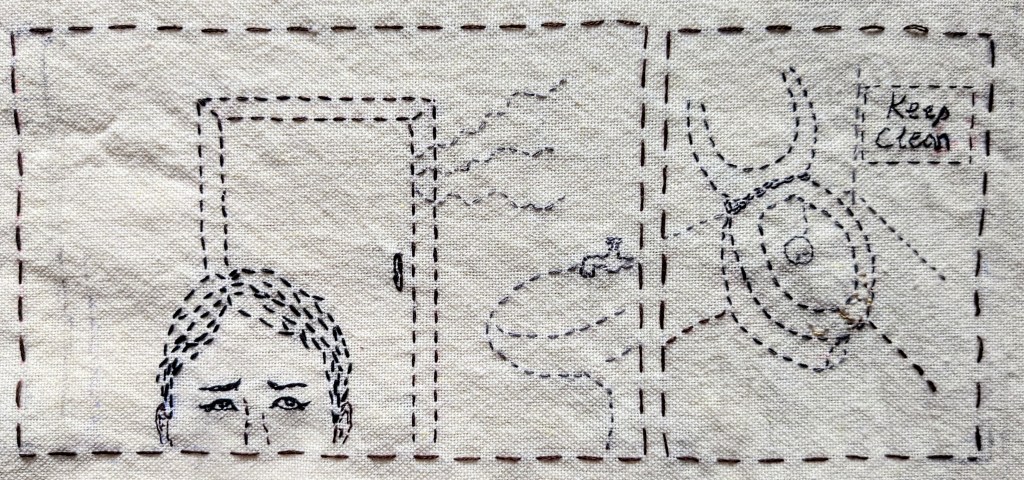
In this project named Kathan (which means conversation in Bangla), I aim to intersect graphic narratives into a multi-media and literary exploration in a large graphic narrative book form by collecting shared experiences, especially of AFAB (assigned female at birth) individuals and queer people of all genders, by having personal conversations with them. This project is implemented by India Foundation for the Arts (IFA) as part of their Explorations (Arts Practice) programme, which is intended for artists to expand their present range of practices in new directions. Through this programme, I have been experimenting and expanding my practice of creating comics and graphic narratives in different mediums of art like embroidery, appliqué, woodcut, and animation. Even at the end of my current project period, the work will still be ongoing, as completion is not the aim of this programme with IFA.
This project would be an anthology of individual experiences, seemingly trivial. I have been having conversations with people belonging to different social classes, genders and locations, and their experiences regarding public toilets and healthcare.
AFAB individuals, having menstruation and being prone to urinary tract
infections, the unhygienic toilets, the social stigma associated with our bodies, and the fear of the
male gaze prevent us from having the liberty to urinate in spaces that are readily accessible to
men for the same purposes. Also, public toilets available are so cis-gender coded that transgender
and nonbinary people feel unsafe or judged while they step into the washroom. This raises
questions about an individual’s right to perform the most basic bodily functions.
Next, the healthcare system is still permeated with age-old biases due to the lack of research and
awareness around women’s health and that of other gender minorities. For example, the cliché
statement “everything will be fine after you get married” is a solution many healthcare
professionals offer to women. Incidents of misgendering and mistreatment of non-cis individuals
often remain unheard. Women were rarely allowed to be included in clinical trials before the
1990s, which creates a significant gap in the knowledge system.
As a queer, non-binary individual who is also assigned female, I have gone through several of
these experiences and their horrors, and have heard many such experiences from others. The
mediums used in the book are so diverse that they can’t be categorized under any umbrella term.
The project intends to address systemic inequities and biases against marginalised genders,
which give rise to problems at an individual level. As it’s about deeply personal experiences,
often not shared publicly, the stories are confined to close circles of people. Unless these stories
are public, until conversations are generated around them, these issues will not be recognised as
affecting a large section of the population. I aim for this project to be an open testimony of these
systemic issues we face on a private level.
I also interact with the contributors consistently and update them at every step of the process to
understand if their experiences are depicted as accurately as possible. A few individuals who
have shared their experiences have also volunteered to sketch or even embroider their own
stories.
I also interact with the contributors consistently and update them at every step of the process to understand if their experiences are depicted as accurately as possible. I am collaborating with some of my peers at different stages in the making of the book. Some individuals who have shared their experiences are also making their sketches and embroidery of their own stories. This is a journey of collaboration, of multiple voices and art styles.
This large book form, preferably set in a public space, combines the tactility of textile (appliqué, felting, and embroidery) and interactive materials (made of found material, metal sheets, air-dry clay, wood carving, etc.) and animation/ video works, challenging the traditional notions of mediums being “masculine/feminine, as well as honouring female involvement in history of textile art, blurring boundaries between art and craft. It derives from the universal tradition of making embroideries together as women used to do throughout history.
This book/anthology is not a one-person work, and it should not be.
The text-visual relationship could be manifested through this multimedia graphic narrative in which the viewers can explore different parts of the narrative by interacting with textile panels, sculptural elements, and video, which will also have movable or foldable elements. I plan to engage with the people by conducting workshops. Pages of this book form will also be left blank to be filled in by any viewer with their lived experiences as part of the workshops. People will not be restricted in any way- they will be encouraged to engage with the work, have conversations, visualise, and add their own experiences. Pages can be added later, hence giving the impression of a NEVER-ENDING BOOK.
I have always hoped text-based art and book forms to have a similar level of space and importance as other practices. Gallery-based exhibitions have an intentional or unintentional exclusivity or limiting characteristic when it comes to the involvement of the common people, often removed from their experiences or interpretations. I want to create something that viewers feel close to their life, something they can touch and contribute to. The mediums used in the book-form are so diverse that they cannot be categorized under any umbrella term. It aligns with my personal philosophy of not fitting into any boxes set by society or the art world.
 Project Kathan